Can You Power Wash a Historic Home? The Preservationist Guide to Safe Exterior Cleaning
- Thomas Latham
- May 26
- 12 min read

Preservation is an act of discipline; for a historic home, the absence of force represents the highest form of precision. Many homeowners look at a weathered facade and ask, can you power wash a historic home to restore its original luster? While the impulse to scrub away decades of grime is understandable, applying 3,000 PSI of pressure to 19th-century brick or delicate lime-based mortar can cause irreversible structural erosion. The very tool designed to clean your property might actually be the one that destroys its irreplaceable character.
We understand the deep sense of stewardship you feel toward your property and the anxiety that comes with choosing a cleaning method that won't compromise its integrity. This guide explores why traditional high-pressure methods are often a liability for heritage materials and how a disciplined soft wash approach offers a safer, more effective alternative. You'll also learn about local regulatory requirements, such as the permit process required by the Philadelphia Historical Commission, to ensure your restoration efforts remain both beautiful and compliant.
Key Takeaways
Understand why the central question of can you power wash a historic home requires a nuanced answer to avoid catastrophic damage to soft-fired bricks and aged mortar.
Discover how soft washing utilizes chemical precision rather than brute force to eliminate organic growth while protecting fragile exterior surfaces.
Learn about the unique challenges posed by regional materials like Wissahickon schist and the specific care required to maintain their structural integrity.
Explore the meticulous "Athlete’s Approach" to property assessment, which prioritizes a detailed pre-cleaning inspection to identify vulnerabilities before work begins.
Gain insight into how professional oversight and advanced low-pressure technology work in synergy to preserve your estate's long-term historical value.
Table of Contents
The Risks of High-Pressure Cleaning for Historic Architecture
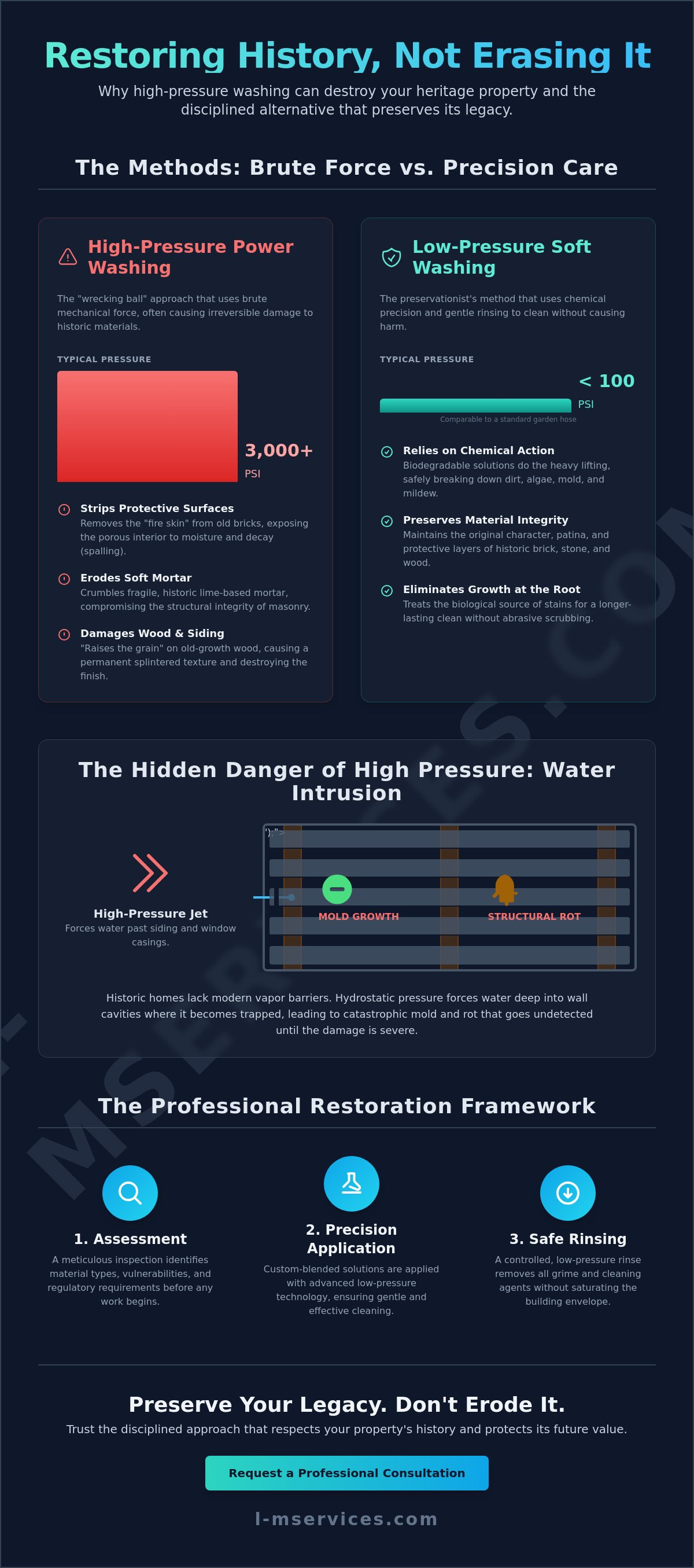
Historic exterior cleaning isn't a standard maintenance task; it's a specialized discipline that requires a deep understanding of material science. When homeowners ask, can you power wash a historic home, the answer must be framed through the lens of architectural preservation. Standard power washing equipment often operates at pressures exceeding 3,000 PSI, which acts as a literal wrecking ball against aged surfaces. This intense force doesn't just remove dirt; it frequently strips away the protective patina and historic glazes that have shielded the structure for a century. While the immediate result might look clean, the process often sacrifices long-term structural health for a temporary aesthetic gain. True stewardship involves looking past the surface to ensure the underlying materials remain sound for the next generation.
Adopting the disciplined alternative for preservation means recognizing that older buildings were constructed with different tolerances than modern ones. High pressure can cause irreversible damage by removing the "fire skin" of old bricks, which is the hard, protective outer layer formed during the kiln-firing process. Once this layer is compromised, the porous interior of the brick is exposed, leading to rapid moisture absorption and spalling. This type of damage is permanent and significantly reduces the lifespan of the masonry.
Material Vulnerability: From Lime Mortar to Old-Growth Wood
Before the mid-20th century, most masonry relied on lime-based mortar, which is significantly softer and more breathable than modern Portland cement. High-pressure streams can easily crumble this friable material, necessitating expensive and delicate repointing. On wood siding, the force of power washing often "raises the grain," creating a fuzzy, splintered texture that destroys the smooth finish characteristic of old-growth timber. These losses represent a permanent erasure of the home's original character-defining details and architectural finesse.
The Hidden Danger of Hydrostatic Pressure and Water Intrusion
The most insidious risk isn't what you see on the surface, but what happens deep within the assembly. Because historic homes lack the sophisticated vapor barriers and rainscreens found in modern construction, they rely on natural airflow and specific permeability to manage moisture. High-pressure washing creates intense hydrostatic pressure that forces liquid water through gaps in siding, around window casings, and directly into wall cavities. The question of can you power wash a historic home must also account for the physics of the building envelope. This water soaks into historic insulation materials or settles against wooden studs. Because these spaces aren't designed to shed bulk water, the trapped moisture frequently leads to internal rot and mold growth that remains undetected until the damage is extensive.
Soft Washing: The Disciplined Alternative for Preservation
When considering the delicate question, can you power wash a historic home, one must look toward a methodology that prioritizes chemical intelligence over mechanical impact. Soft washing represents this disciplined evolution. It's a specialized process that replaces the high-velocity streams of traditional power washing with a gentle, low-pressure application. By utilizing specialized nozzles that deliver water at a pressure comparable to a standard garden hose, this technique ensures that the cleaning solution does the heavy lifting. This approach aligns with The Professional Restoration Framework, which emphasizes the least invasive means possible to achieve conservation goals. It's not about the brute force of the stream; it's about the precision of the application.
The transition from high-pressure methods to soft washing is a shift from abrasive cleaning to restorative care. While traditional power washing might provide a momentary sense of cleanliness, it often fails to address the biological roots of stains and can inadvertently damage the substrate. Owners of heritage estates often find that a professional residential soft washing service provides the necessary balance between aesthetic renewal and structural preservation. This method treats the home as a living piece of history rather than a modern surface to be scrubbed.
The Science of Chemical Cleaning vs. Mechanical Force
The efficacy of soft washing lies in the synergy of professional-grade surfactants. These agents work by breaking the surface tension of water, allowing the cleaning solution to penetrate deep into the microscopic pores of historic brick, stone, and wood. Instead of merely "shaving off" the surface layer of organic growth, these solutions kill moss, algae, and lichen at the root. This systemic approach ensures a more thorough clean and significantly extends the time between maintenance cycles. Because the biological spores are neutralized rather than just displaced, the results typically last four to six times longer than those achieved through traditional high-pressure methods.
Why Bio-Degradable Solutions Protect Your Historic Landscape
Historic properties are frequently defined by their mature landscaping and established ecosystems. We recognize that the preservation of a home includes the protection of its surrounding environment. The cleaning agents used in a disciplined soft wash are biodegradable and eco-friendly, designed to break down safely without leaving harmful residues. Our protocols include meticulous pre-wetting of all adjacent foliage to create a protective water barrier on leaves and soil. Following the application, a comprehensive post-rinse ensures that the landscape remains as vibrant as the newly cleaned facade. These steps guarantee that the process is safe for pets, pollinators, and the local watershed, reflecting a commitment to holistic property stewardship.
Historic Materials of Greater Philadelphia: A Specialized Approach
Philadelphia's architectural landscape is defined by its use of indigenous materials that demand a localized understanding of preservation. From the mica-flecked Wissahickon schist of Chestnut Hill to the traditional stucco found throughout King of Prussia, these surfaces require a bespoke approach that respects their unique physical properties. For a deeper look at regional care, consult our comprehensive guide on exterior home maintenance in King of Prussia & Philadelphia: A Preservation Guide. Understanding these materials is the first step in ensuring their longevity and aesthetic brilliance.
When residents ask, can you power wash a historic home, they must consider the extreme sensitivity of regional stucco. Traditional Philadelphia stucco is often applied over stone or wood lath and is significantly more breathable and fragile than modern synthetic alternatives. High pressure can cause delamination or force moisture into the substrate, leading to catastrophic failure of the finish. This risk is a primary reason why The Risks of High-Pressure Cleaning for Historic Architecture are so frequently cited by preservationists. Aggressive methods strip away the protective surface layers of historic masonry, leaving the building vulnerable to the elements.
Cleaning Wissahickon Schist and Local Masonry
Wissahickon schist is prized for its glittering appearance, but its layered mineral composition makes it prone to "scaling" if it's subjected to intense mechanical force. Cleaning this stone requires a gentle touch to avoid disturbing the natural "crust" that has developed over decades, which provides a vital layer of weather resistance. Additionally, improper cleaning can trigger efflorescence, where salt deposits migrate to the surface and create unsightly white staining. A soft wash approach neutralizes these minerals and biological growth without agitating the stone's delicate structure or stripping its character.
Protecting Century-Old Wood Siding and Lime Mortar
In areas like King of Prussia, century-old cedar shake and clapboard siding remain common architectural features. These old-growth woods are exceptionally durable but become brittle with age. You can't treat these surfaces with high pressure without risking deep gouges or "fuzzing" the wood fibers. Soft washing is the only viable method for cleaning these homes while preserving the integrity of the lime-based mortar joints that hold the masonry together. This process also serves as a critical first step in professional maintenance, ensuring a clean, stable surface for future repainting without the structural damage associated with abrasive scrubbing.
The Professional Restoration Framework: Assessment and Execution
Successful preservation relies on a methodology we call the Athlete’s Approach. This framework prioritizes meticulous preparation and a disciplined execution that mirrors the focus of a professional competitor. Before any equipment is staged, a comprehensive pre-cleaning inspection is mandatory. We examine the facade for structural vulnerabilities such as hairline fractures in masonry or failing caulk around historic window casements. When homeowners ask, can you power wash a historic home, they often overlook these subtle entry points where high-pressure water could cause immediate internal damage. A professional assessment identifies these risks early, allowing for a customized strategy that respects the home's specific condition.
The execution phase involves more than just cleaning; it's about the total protection of the estate's assets. This includes masking and shielding delicate fixtures that define the property's character. Hand-blown glass panes, antique copper lanterns, and original hardware are all vulnerable to even minor overspray or specific cleaning agents. By creating a protective barrier around these elements, we ensure the focus remains solely on the restoration of the substrate. Once the process is complete, a post-cleaning evaluation confirms that all organic growth has been eradicated at the microscopic level, preventing rapid regrowth and ensuring the longevity of the clean.
Lead Paint Considerations and EPA Lead-Safe Practices
For properties constructed before 1978, the management of lead-based paint is a critical safety consideration. The EPA's Renovation, Repair, and Painting (RRP) rule dictates specific standards for handling these materials to prevent environmental contamination. High-pressure washing is strictly prohibited on lead-painted surfaces because the force can pulverize the paint, releasing toxic dust or sending chips into the soil. Soft washing serves as a superior alternative. The low-pressure application minimizes the risk of disturbing the paint film while effectively removing the biological growth that accelerates paint failure. This protects your family and the local ecosystem from hazardous exposure.
Post-Cleaning Preservation and Maintenance
Maintenance is a continuous cycle rather than a one-time event. Once organic growth is removed, maintaining proper drainage becomes the next priority in preserving the building envelope. Overflowing gutters are a primary cause of the damp conditions that invite mold and algae back to your siding. Integrating gutter cleaning in King of Prussia & Philadelphia into your annual schedule ensures that water is diverted away from sensitive masonry and wood. Most historic estates benefit from a soft wash evaluation every two to three years to maintain peak curb appeal. If you are ready to secure the future of your heritage property, consider a professional exterior assessment to determine the safest path forward.
The L&M Services Standard: Precision Care for Historic Estates
Maintaining a heritage estate is a responsibility that extends beyond simple curb appeal; it's a commitment to cultural continuity. When you ask, can you power wash a historic home, the answer depends entirely on the level of professional oversight and technical precision applied to the task. At L&M Services LLP, we don't view ourselves as a simple vendor but as a strategic guardian of your property’s structural and historical integrity. Our operational baseline is defined by the best power washing King of Prussia: The 2026 Precision Standard, a framework that ensures every square inch of your home receives the exact level of care it requires. We achieve this through a seamless synergy of human expertise and advanced soft wash technology, ensuring that the character of your home is never compromised by the tools meant to preserve it.
Professional stewardship is particularly vital when navigating the regulatory landscape of the Greater Philadelphia area. As verified by the City of Philadelphia Department of Licenses and Inspections in early 2026, cleaning a designated historic property is often classified as an alteration, requiring specific building permits and Historical Commission review. Our team understands these nuances, providing the quiet confidence and reliability you need when entrusting your global reputation and local legacy to a third party. We move methodically from the initial assessment to the final delivery of value, ensuring a process that is as disciplined as it is effective.
Our Athlete-Driven Methodology for Property Maintenance
The foundation of our service delivery is rooted in our founders’ background as Division 1 athletes. This experience instilled a culture of relentless discipline and a meticulous approach to job-site management. In the world of historic preservation, there is no room for error. We maintain a strict "no shortcuts" policy when dealing with delicate materials like Wissahickon schist or lime-based mortar. This athlete-driven mindset ensures that our team remains focused on the precision of the process, prioritizing professional reliability and clear communication at every stage of the project. You can expect a service rhythm that is steady, structured, and entirely focused on the human element of property care.
Custom Cleaning Plans for King of Prussia and Philadelphia Homes
Every historic property in our region possesses a unique architectural DNA that requires a customized service model. We don't believe in a one-size-fits-all approach; instead, we adapt our low-pressure protocols to match the specific age, material, and condition of your residence. We invite you to experience the expert power washing in Philadelphia & King of Prussia difference, where sophisticated technology meets old-world craftsmanship. Whether you own a colonial-era farmhouse or a mid-century masterpiece, our goal is to provide a level of excellence that prioritizes your home's longevity. Contact us today for a personalized property preservation assessment and discover how our disciplined soft wash solutions can safeguard your investment for decades to come.
Safeguarding the Architectural Legacy of Your Estate
Preserving a heritage property requires a transition from reactive maintenance to a disciplined strategy of stewardship. While the question of can you power wash a historic home often arises from a desire for visual renewal, the true goal is the enduring health of the structure. We've explored how low-pressure soft washing protects fragile substrates like Wissahickon schist and lime mortar; this ensures that organic growth is neutralized without compromising physical integrity. By prioritizing professional assessment and EPA lead-safe aware practices, you prevent the hidden risks of water intrusion and material erosion.
Our methodology, founded by D1 athletes, brings job-site discipline and specialized historic material protocols to every project. We understand that your home is an irreplaceable asset that deserves more than a standard vendor relationship. As your strategic partner, we provide the technical precision and personal oversight necessary to maintain your property's dignity and value. You are invited to Request Your Historic Property Preservation Quote today to begin a customized care plan. Your home's history is a story worth telling; let's ensure it remains vibrant for generations to come.
Frequently Asked Questions
Is soft washing safe for homes with lead-based paint?
Soft washing is considered the safest professional method for cleaning homes that contain lead-based paint. Because this technique avoids the abrasive force of high-pressure streams, it doesn't pulverize the paint film into hazardous dust or dislodge toxic chips into the surrounding soil. This low-impact approach allows for a thorough cleaning of the facade while maintaining the stability of the lead-containing layers and adhering to safety standards.
Will soft washing remove heavy moss and lichen from my historic roof?
Soft washing is highly effective at eradicating heavy moss and lichen from historic roofing materials without causing mechanical damage. The specialized surfactants penetrate the root systems of these organisms, neutralizing them at the source so they can be gently rinsed away. This process is far superior to scrubbing or high-pressure methods, which can easily dislodge fragile shingles or strip away protective granules on older roofs.
How long does a professional soft wash treatment last on an old house?
A professional soft wash treatment typically maintains its results for a period four to six times longer than traditional high-pressure methods. Because the cleaning solutions neutralize organic spores at the microscopic level, the biological regrowth of algae and moss is significantly delayed. This longevity makes soft washing a cornerstone of disciplined property stewardship, as it reduces the frequency of cleaning cycles required for your estate.
Can soft washing damage my historic landscaping or garden?
Soft washing doesn't damage historic landscaping when performed with the correct protective protocols. Our process includes a meticulous pre-wetting of all adjacent foliage to create a natural water barrier on leaves and in the soil. Following the application of our biodegradable solutions, a comprehensive post-rinse ensures that no residue remains on your botanical assets, keeping your garden as vibrant as your newly cleaned home.
How do I know if my home needs a soft wash or a traditional pressure wash?
The choice between methods depends on the durability and age of the substrate being cleaned. While modern concrete surfaces can often handle higher PSI, the question of can you power wash a historic home almost always results in a recommendation for soft washing. Historic materials like soft-fired brick, lime mortar, and aged wood lack the structural density to withstand intense force without suffering permanent erosion.
What happens if water gets behind my historic wood siding during cleaning?
Soft washing significantly minimizes the risk of water intrusion because it utilizes a low-pressure application similar to a standard garden hose. Unlike traditional power washing, which can force bulk water behind siding and into sensitive wall cavities, soft washing relies on chemical intelligence to lift grime. This protects your home's internal envelope from the moisture-related rot and mold growth that often follows aggressive mechanical cleaning.
Are the cleaning solutions used in soft washing biodegradable?
The professional-grade surfactants used in our soft wash process are fully biodegradable and designed for environmental compatibility. These solutions are formulated to break down into harmless components shortly after they've neutralized the organic growth on your home's exterior. This ensures that the cleaning process is safe for your family, your pets, and the local watershed, reflecting a sophisticated commitment to holistic property care.
Does soft washing help prepare my historic home for a new paint job?
Soft washing is an ideal preparation step for a new paint job because it provides a perfectly clean substrate for optimal adhesion. It removes all biological contaminants and surface debris without "fuzzing" wood fibers or damaging the underlying masonry. By ensuring a stable and neutralized surface, soft washing helps your new coat of paint last longer and look smoother, all while preserving the home's structural integrity.
Comments